Arrival, and the lane
Rectory Lane leaves the Bourton road, narrows to a single track with passing places, runs for six hundred yards between hedges too high to see over, and stops at a gate. There is nothing after the gate. This matters more than it sounds: a great many Cotswold hotels are excellent buildings on tolerable roads, and the difference a dead-end lane makes to an evening is the whole of the argument for coming here.
The door was opened before the car doors were. Bags were taken without the usual negotiation, and check-in happened in an armchair by the fire with a pot of tea that had been made in anticipation rather than in response. Nobody asked for a card. The house takes nothing in advance and settles everything on departure, which in 2026 is an eccentricity worth naming.
The house itself
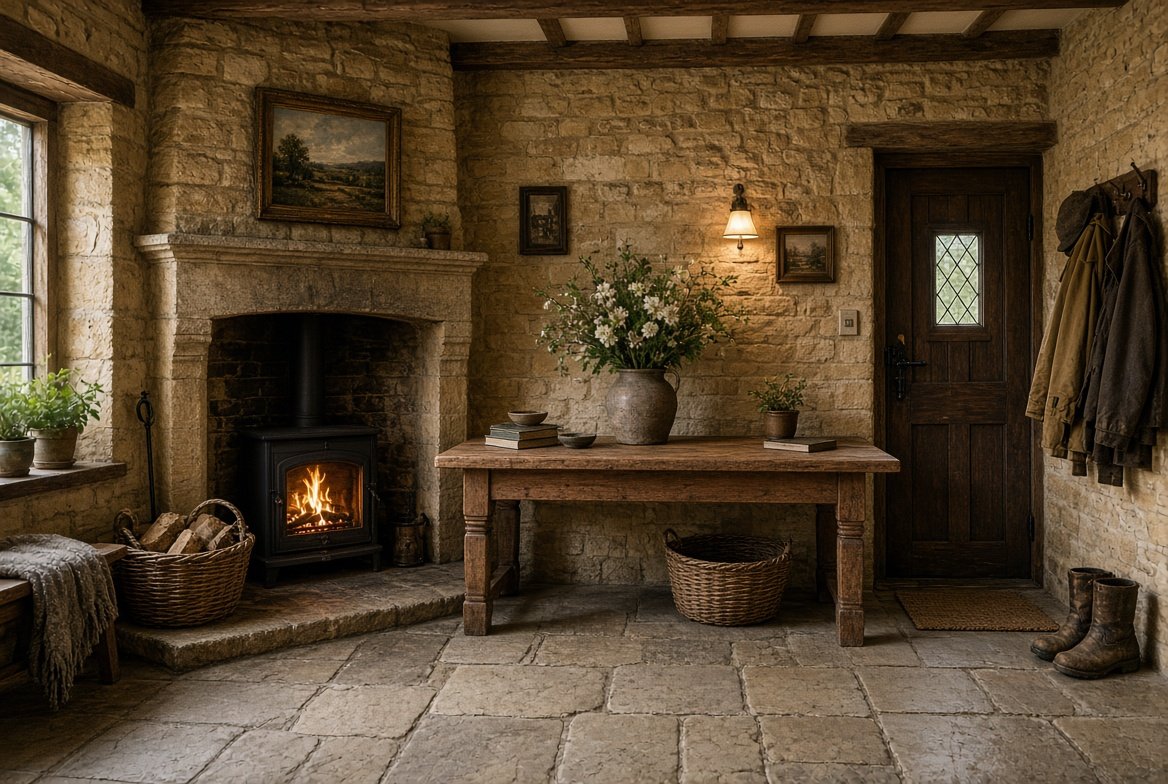
Seventeenth-century at its core, Victorian at the edges, and honest about both. The stone is the local oolite that turns the colour of a digestive biscuit in low sun. Inside, the floors slope, the door frames are low in two places on the second floor, and a board on the back stair announces itself at about eleven every night when somebody goes up to bed.
The 2021 conversion resisted almost every temptation available to it. No glass extension, no reception desk, no signage beyond a painted board at the gate. The money went where guests feel it and cannot see it: a new boiler plant in the old coach house, radiators that heat a 1673 room to a sensible temperature in February, and water pressure on the second floor that produces a shower rather than an apology.
Twenty-four rooms across four buildings keeps the public rooms quiet. On the June visit the house was full and the hall at six in the evening held five people.
The rooms
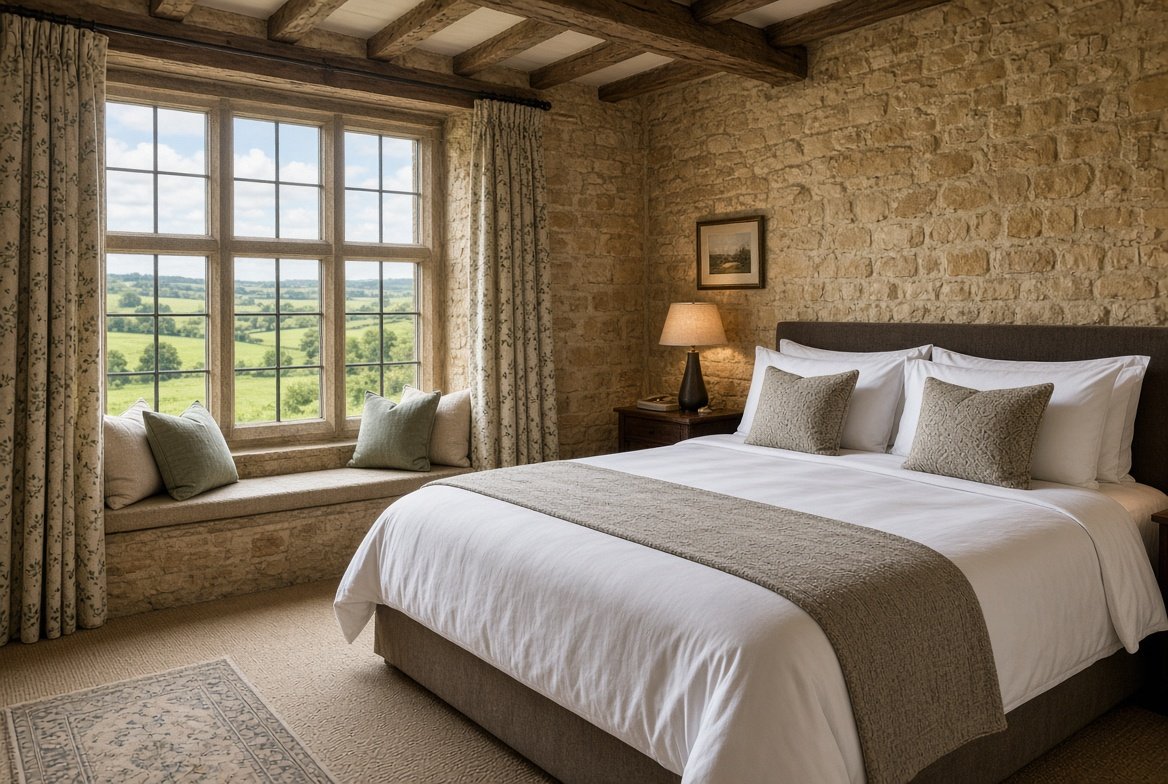
The Rectory Double in February was room 7, at the front, twenty-four square metres with a mullion window deep enough to sit in. It is a small room by the standards of the price, and the bathroom is a shower room rather than anything grander. What it has instead is a view that runs past the churchyard wall to open fields, a bed that is properly six feet wide, and a silence at night that is close to total — broken twice, over two nights, by an owl.
The Stable Loft in June was a different proposition. Its own stair off the yard, no corridor to share, a ceiling of open timbers about fifteen feet at the ridge, and a roll-top bath positioned where somebody clearly stood and thought about where the evening light falls. For an extra eighty-five pounds it is the better room, and for anybody arriving with a dog or with muddy boots it is not a close contest.
Two complaints, both small. The blackout in the stables is good but not perfect, and in mid-June the light is up before five. And there is no bedside socket on the left-hand side in room 7 — a modern irritation in an old building, and one the staff were quite ready to solve with an extension lead.
Dinner, breakfast and the bar
Dinner is three courses with two choices at each, fifty-eight pounds, written at midday when the gardeners bring in what they have. Over two visits: a whole turbot for two with brown butter; mutton that had been in the oven since breakfast, with turnips; gooseberries and elderflower in June and a quince tart in February. Kate Marlow's cooking is plain in the way that takes work, and the sourcing is not a story on a card — the vegetables genuinely walked forty yards.
Breakfast is the meal the house wins on. Eggs from the paddock, bacon from a farm in Northleach, bread baked overnight, and the newspaper you asked for the night before, ironed or not depending on who is on. There is no buffet anywhere in the building.
The Snug is one room, one fire and a bar the length of a door, with Donnington on tap from four miles away. It shuts at eleven because there are bedrooms overhead, and nobody pretends otherwise.
The single real weakness is the shape of the week. There is no dinner on Monday or Tuesday, when the kitchen closes and the bar does soup, a pie and cheese. That is entirely defensible for a house this size and thoroughly annoying if you happen to arrive on a Monday, so know it before you book.
The garden and the grounds
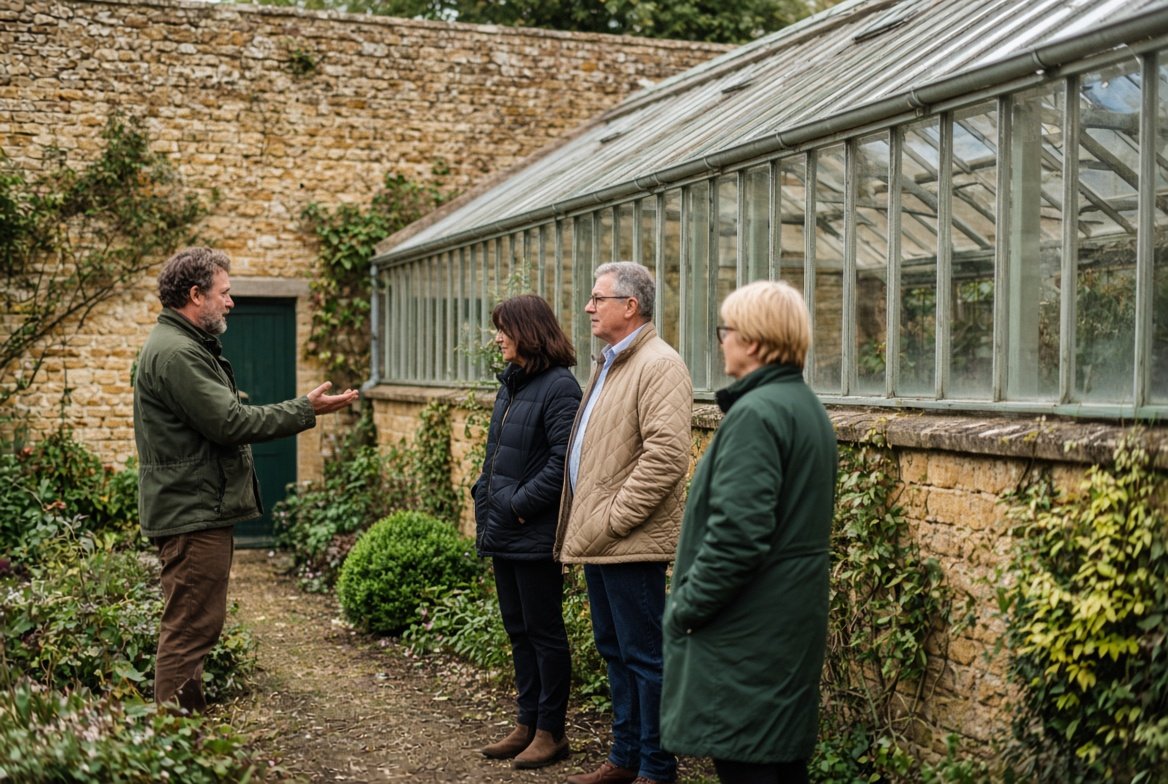
Eleven acres: lawn, paddock, orchard, and an acre of walled kitchen garden that is the best thing on the property. Two gardeners work it and one of them walks anybody who turns up around it on a Saturday morning for half an hour. It is not a performance, there is no charge, and it produced more genuine pleasure over six nights than anything that could have been charged for.
Beyond the gate, the Windrush. The hotel holds a mile of single-bank fishing, two rods a day, wild brown trout and grayling, catch and release. The Slaughters loop — three flat miles — leaves from the same gate and is worth doing before nine, when the villages are still empty.
Service
Eighteen staff for twenty-four rooms, and a number of them local enough to have opinions about the lane. The register is warm and unstarched: first names, no scripted greetings, and nobody hovering. Over six nights the only genuine test came when a car battery died in the car park on a Sunday; a jump lead appeared in eleven minutes and the offer of a lift to the station came before it was asked for.
Housekeeping worked around a spread of papers for four days without moving a page. The boot room had a towel out for a dog that was not ours. Twice, tea appeared in the hall at the moment somebody came in wet, without being requested.
What there is instead of a spa
There is no spa, no pool, no sauna and no gym, and the house says so on the telephone rather than letting guests discover it. What exists is a single treatment room above the stables where two therapists take bookings from nine to seven — an hour's massage is seventy-five pounds and needs a day's notice.
For anybody whose idea of a country weekend involves a thermal circuit, this is the wrong house and the staff will happily say so and point at one of the larger estates twenty minutes away. For anybody whose idea of it involves a five-mile walk and a bath afterwards, the absence is not felt at all.
What to keep in mind
Plainly, and in the order they are likely to matter:
- No dinner on Monday or Tuesday. The bar does supper, which is good, but it is soup and a pie. Plan the week around it.
- No lift, and old stairs. Fifteen steps with a turn to the first floor, low frames on the second. The step-free rooms are in the stable range, and there are only two.
- No spa. One treatment room, booked out at weekends.
- Mobile signal is poor. One bar of 4G in the garden on a good day. The wi-fi is fast and there is a landline in every room; the disconnection is mostly a feature, occasionally a nuisance.
- The lane is single track. Fine in daylight, tighter after dark, and genuinely awkward if you meet a tractor. Approach from the Bourton end.
- Dogs are not in the main house. Stables and cottage only. Dog owners should book early, since six rooms is not many.
- It is not cheap. Two hundred and forty-five pounds is the floor, and dinner for two with a bottle adds comfortably over a hundred and fifty.
The verdict
This is a small house doing a short list of things carefully: a quiet site, honest rooms, a kitchen garden that actually feeds the kitchen, and a staff who have been there long enough to notice things. It is not a resort, it has no wellness offering worth the name, and for two days a week it cannot cook you dinner.
Book it for two or three nights of walking, eating and sleeping, ideally from a Wednesday. Take a Stable Loft if you can, or the Windrush Suite if the weather looks poor and you want a fire of your own. Do not book it for a spa weekend, and do not arrive on a Monday expecting the full picture.
In one line
A serious, unshowy country house that is better than its price on breakfast, garden and staff, and quite open about the three things it does not do. Strongest midweek; weakest on Mondays.